What's been the impact of Speedrun Ethereum on the Ethereum developer ecosystem?

Every developer ecosystem faces the same question: are your onboarding programs actually working, or just generating vanity metrics?
Speedrun Ethereum (SRE) is one of the most recognizable developer programs in crypto — a self-paced challenge series that has attracted over 17,000 signups since launch. But signing up is easy. The harder question is whether SRE is converting newcomers into sustained Ethereum contributors.
We conducted this analysis as part of a broader inquiry into the state of the Ethereum developer ecosystem, grounded in a simple premise: developer retention is a leading indicator of ecosystem health. With AI and other ecosystems competing for ambitious developers, bottom-up programs like SRE matter more than ever. We used public data to see if it's actually working.
The data behind the program
We linked SRE's participant registry to public GitHub activity data from Open Dev Data and GitHub Archive using the OSO data lake. Of the 17,000+ signups to date, 2,376 have public GitHub handles that we can track. These developers span a wide range of backgrounds:
- 707 Experienced — 12+ months of GitHub activity before joining SRE
- 801 Learning — 3–12 months of prior activity
- 868 Newbs — less than 3 months, including students and career-changers
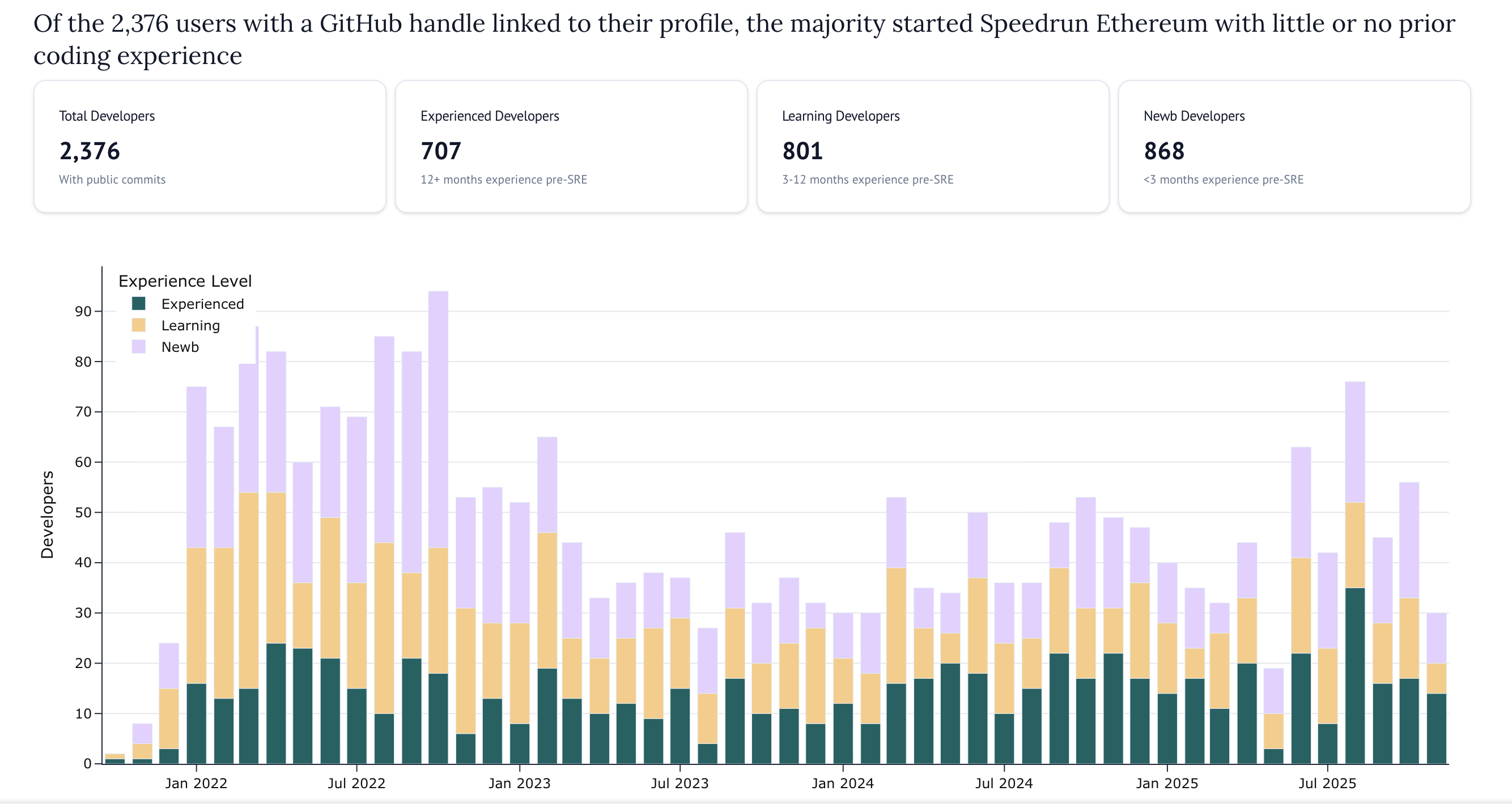
Intake has been steady over the life of the program, with a consistent mix of experience levels across market cycles.
From signup to sustained contributor
Not every signup becomes a contributor. We tracked the full funnel from SRE registration through challenge completion to ongoing Ethereum contributions. The key drop-off points are not surprising: moving from signup to completing one or more challenges, and then from challenge completion to making meaningful contributions to one or more Ethereum ecosystem repos.
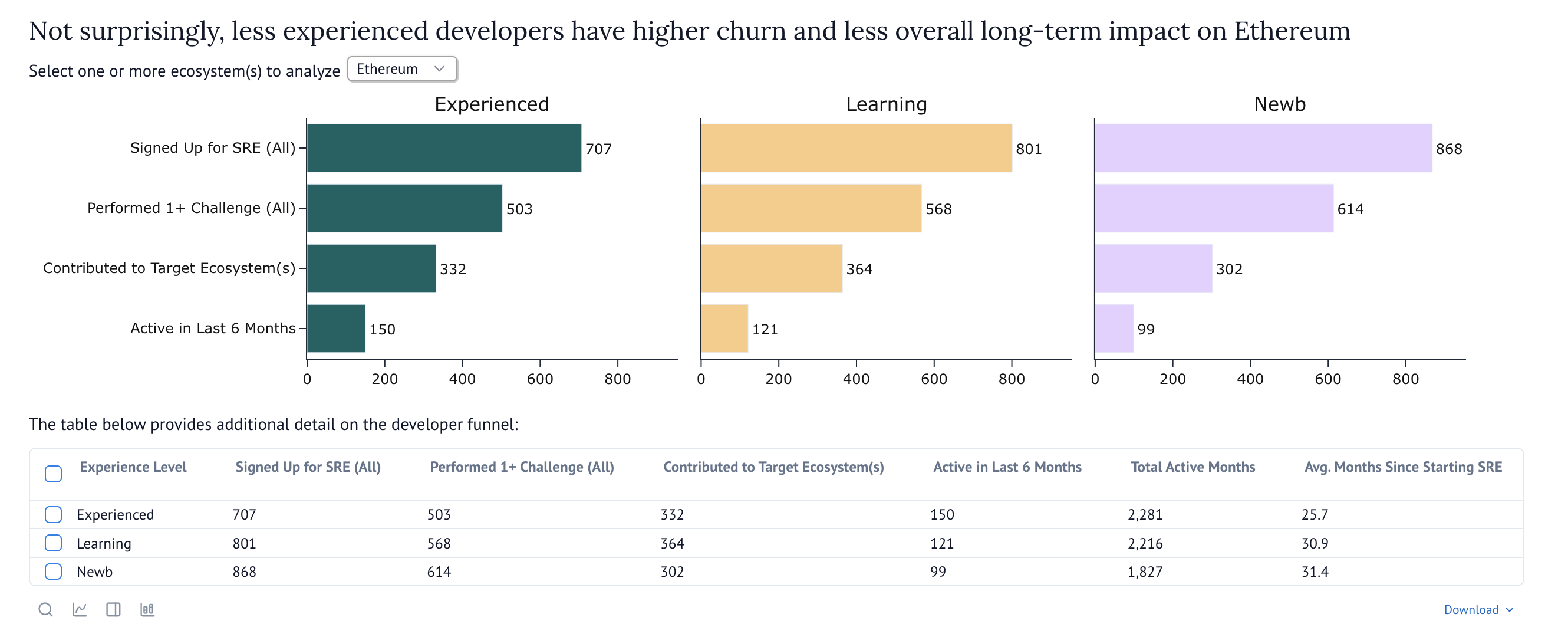
Experienced developers convert at significantly higher rates across every stage: of 707 experienced developers, 332 contributed to the Ethereum ecosystem and 150 remain active in the last six months. Among 868 newbs, 302 made it to ecosystem contributions and 99 are still active. The drop-off is steeper for newcomers, but the absolute numbers are meaningful.
Experience matters — but the program still works
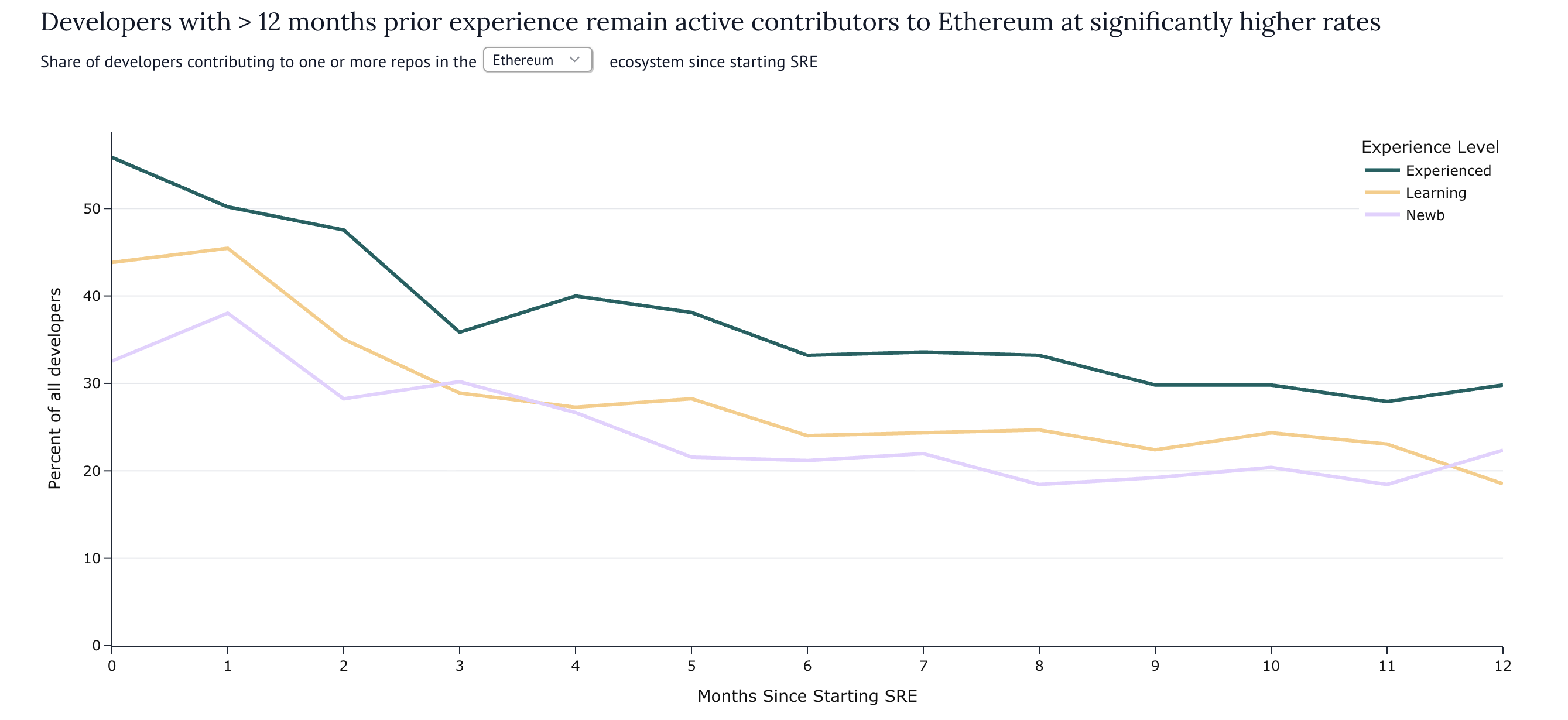
The retention data tells a more nuanced story. Experienced developers stay active on Ethereum projects at roughly 30% after 12 months, compared to about 20% for newbs. That's a meaningful gap, but the fact that SRE retains newcomers at 20% over a year is notable for a free, self-paced program.
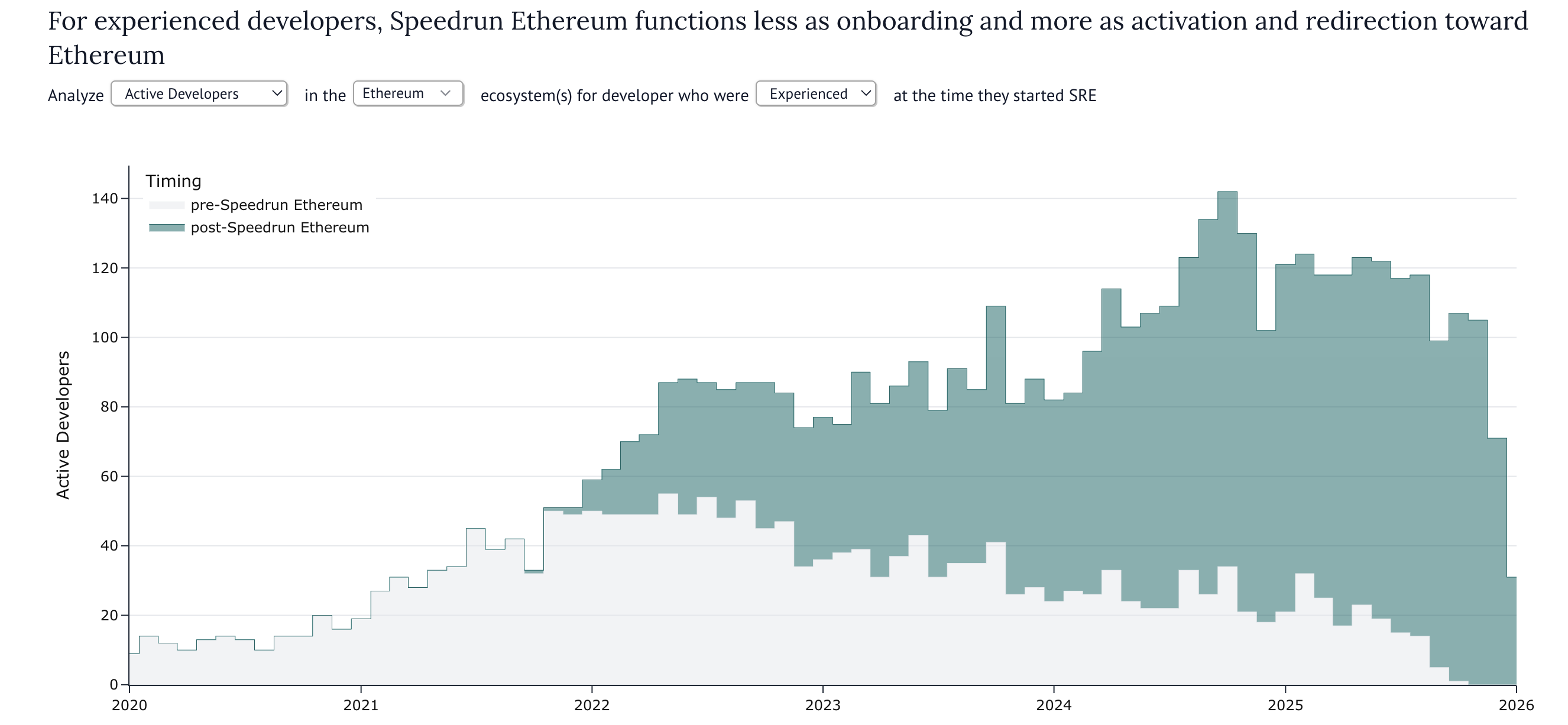
The most important finding is at the aggregate level: SRE has contributed approximately 250 incremental monthly active developers to Ethereum. That's the net increase in Ethereum-active developers attributable to SRE alumni relative to their pre-SRE baseline. The program went from roughly 20 active participants early on to more than 250 regularly contributing to Ethereum repos.
One other pattern stands out from the retention data: engagement past the three-month mark is a strong predictor of long-term retention. Across all experience levels and cohort years, developers who make it past the first 90 days are substantially more likely to stay and contribute on an ongoing basis. The retention curve flattens noticeably after month three. If someone is still active at that point, they're much more likely to stick around.
These findings have implications for program design. The first 90 days are the critical window. Structured interventions during this period — office hours, mentorship, opportunities to demo work, connections to teams hiring — could improve conversion from "curious participant" to "sustained contributor."
Where do graduates go?
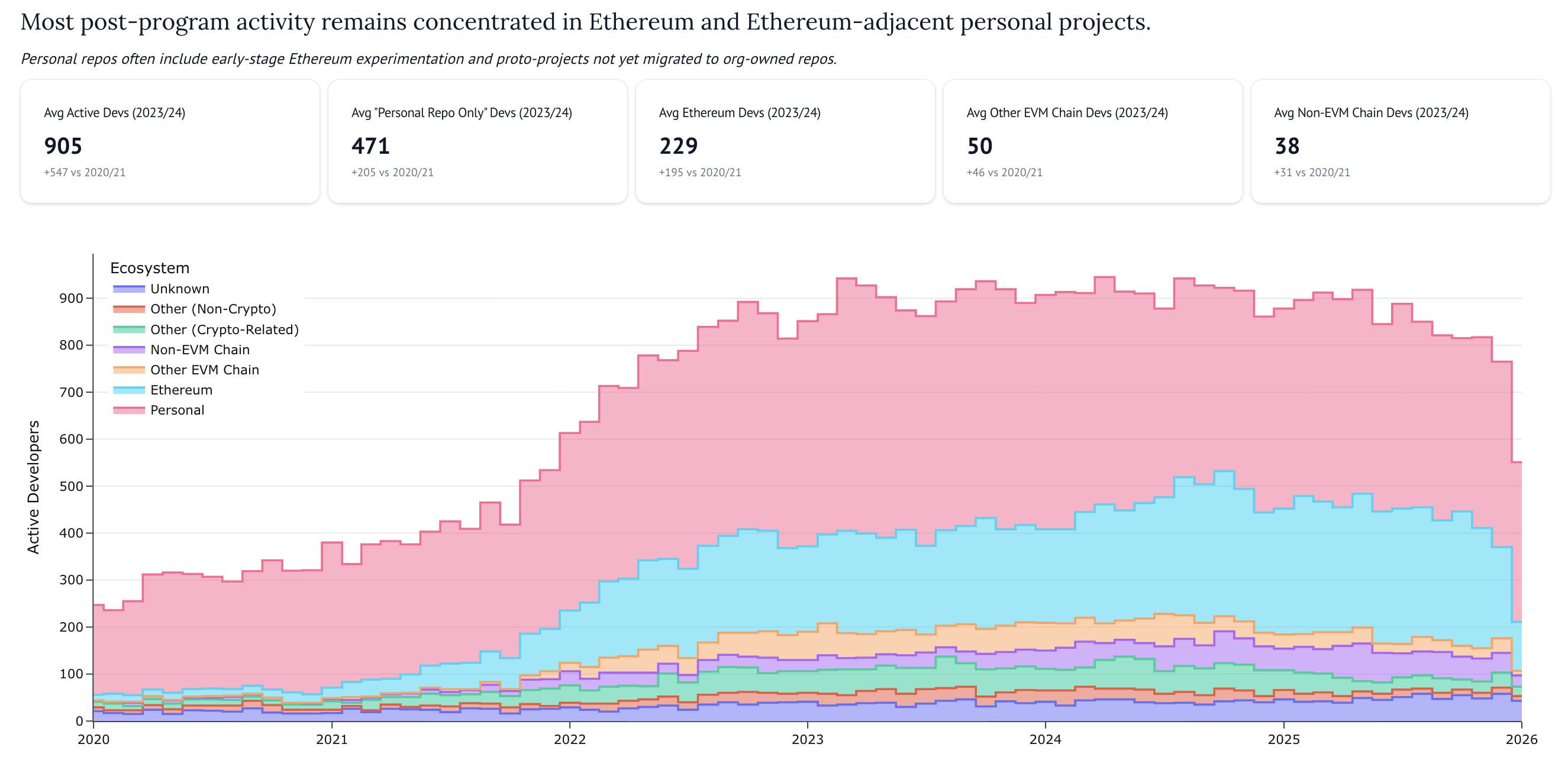
A natural concern with any onboarding program is whether it trains developers who immediately leave for competing ecosystems. The data here is also encouraging: most post-program activity remains concentrated in Ethereum and Ethereum-adjacent personal repos. In 2023/24, SRE alumni averaged 905 active developers per month: 229 contributing directly to Ethereum repos, 471 working in personal repos (which often include early-stage Ethereum experimentation), and relatively small numbers moving to other EVM or non-EVM chains.
We also mapped the specific organizations where SRE alumni land. The names skew toward governance and public goods — e.g., Gitcoin, Juicebox, Safe, Tally — rather than consumer apps or DeFi protocols. This makes sense given the program's own origins as a public goods project. However, going forward, there's an opportunity to create stronger pathways between SRE and Ethereum organizations actively hiring. For newer developers, that means internships and junior roles at teams building public goods infrastructure. For experienced developers, it could mean pathways that start with fullstack contributions and evolve toward deeper protocol work.
The talent pipeline exists — the question is how to make transitions from learning to working more direct for strong performers.
Try it yourself
All of the data behind this analysis is public and the notebook is fully interactive — built with marimo and running on live data from the OSO data lake. You can filter by ecosystem, experience level, cohort year, and time period to explore the data yourself. You can also flip the notebook over to see every SQL query and line of Python that generates these charts.
- Speedrun Ethereum — try the program yourself
- OSO data lake — query the same data with Python
- Interactive notebook — run it live or download the code